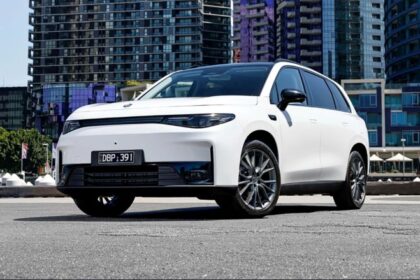
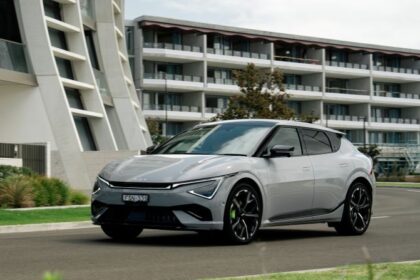
Trailseeker is the Subaru version of the all-wheel drive Toyota bZ4X Touring (the
140mm longer version of the bZ4X).
Sibling, the Solterra, is the Subaru equivalent of the standard or shorter bZ4X (this
one comes in front- or all-wheel drive).
In Europe and the UK, Trailseeker is badged as the E-Outback, suggesting it will
eventually replace Outback as Subaru moves towards full electrification.
It’s got the same look and feel as the Outback (well, maybe not feel), but for the time
being at least — Subaru says the two will co-exist. Join the dots.
Remember, we haven’t even seen a hybrid version of Outback yet.
There’s another ‘Toyotaru’ to come too, the Unchartered, based on the Toyota C-
HR+ (not here yet either).
For a relatively small Japanese car maker like Subaru, badge engineering is a good
way of jumping the queue, without spending vast amounts on R&D.
STYLING
There are two versions, AWD from $67,990 and Touring from $73,990 (Outback
starts from $56,000 driveaway).
From all appearances, it’s cast in the same mould as Outback, riding high, more
wagon than SUV, with joined tail lights incorporating the Subaru name, channeling
the pioneering Liberty.
The dash is busy, with a large central screen, small odd shaped steering wheel, and
lots of knobs and switches competing for attention. The mitred driver display is set
well back from the wheel in a bid to negate the need for a head-up windscreen
display, in the way that Peugeot does.
The large centre touchscreen is busy too, with large physical knobs for temperature,
as well as three rows of electronic tabs along the bottom.
Big is easy rather than fiddly, but it’s slow to respond, sometimes taking three or
more solid taps to elicit the desired response.
The entry, AWD model is certainly no stripper version, but a well equipped offering
with artificial leather and dual zone climate control with rear vents, a heated steering
wheel, heated and cooled power-adjust front seats, heated reclining rear seats, and
electric lumbar adjustment for the driver.
There’s also adaptive cruise control, speed sign recognition, LED lights front and
back, auto lights and wipers (but no auto high beam), power fold mirrors, tinted rear
glass, hands-free tailgate, and multi-colour interior lighting.
A digital mirror replaces the conventional rear-view mirror, providing a wider,
unobstructed view rearward regardless of passenger or cargo load — we loathe
them.
The switch that normally toggles between day and night changes between the digital
and standard formats, and while the digital mirror may offer some benefits it is
difficult to focus on quickly, especially with multi-focal glasses.
AWD gets 18-inch wheels with ‘aero’ wheel covers while Touring steps up t0 20-inch
full alloy wheels.
The Touring model adds leather-accented seating, a panoramic glass roof, 10-
speaker Harman Kardon audio, with a separate subwoofer and amplifier, and
Advanced Park Assist with four Panoramic View Monitor cameras and 12 ultrasonic
sensors.
The price for both grades includes a 5-year unlimited kilometre warranty,
complimentary 5-year service plan (60 months/75,000km), 5-year roadside
assistance, and a 2kW (8A) AC charging cable with 10A wall plug for charging.
The high voltage battery is covered by an eight-year/160,000km warranty.
Subaru’s Map Update Program provides map updates for the first three years.
INFOTAINMENT
The infotainment system relies on just two screens, a 14.0-inch centre landscape
touchscreen and 7.0-inch mitred driver display. At one stage Subaru offered three of
the bloody things.
There’s Bluetooth, voice control, AM/FM and DAB+ digital radio, satellite navigation,
wireless Apple CarPlay and Android Auto and six-speaker audio.

Subaru has always been noted for its audio systems and the Trailseeker is no
exception. The bz4X gets a nine-speaker JBL unit, but if you want a name, however,
you’ll have to pop for the Touring.
The good news is that the standard system is pretty good. The low notes had the
rear vision mirror vibrating so badly it was impossible to see what was behind the
car. LOL.
Dual wireless Qi chargers in the front centre console keep two devices powered
simultaneously.
There’s also two USB-C ports front and back and a 12 volt/120 watt power outlet
(Touring supports V2L).
SAFETY
Trailseeker scores five stars for crash safety, with eight airbags, including a driver
knee airbag and front centre airbag, along with a 360 degree monitor, and auto
emergency braking (Car-to-Car, Vulnerable Road User, Junction & Crossing,
Backover and Head-On).
There’s also a lane support system with lane keep assist (LKA), lane departure
warning (LDW) and emergency lane keeping (ELK), and a speed assist system
(SAS) are standard.
A full Vision Assist suite encompasses Adaptive High-Beam System, Blind Spot
Monitor, Multi-Terrain Monitor, Rear Cross Traffic Alert and Safe Exit Assist, helps
the driver stay aware of the world around the vehicle.
A Driver Monitor System uses an in-cabin camera to provide distraction and
drowsiness warnings.
There are three rear top-tether and two ISOFix child-seat anchors.
ENGINES / TRANSMISSIONS
With two electric motors, a single-speed reduction gear style transmission and all-
wheel drive, Trailseeker offers 280kW of power and 536Nm of torque.
That’s enough to propel the five-seat SUV from 0-100 km/h in about 4.5 seconds,
making it faster than a WRX – as well as the fastest production Sooby ever sold in
Australia.
That’s no mean feat.
DRIVING
At 4845mm Trailseeker is 25mm or an inch shorter than Outback.
It’s long and station wagon-like too, a facet you don’t appreciate until seeing it in
profile.
It has the same sort of roof rails, ground clearance and dark ‘off-road’ plastic
cladding that define the original.
With optional crossbars fitted, it can carry bike racks, kayak cradles, roof boxes and
even rooftop tents.
Trailseeker is quiet inside too, with the only intrusion a little tyre noise, particularly on
coarse bitumen.
With two electric motors, one for the front axle and another for the rear, plus a 75
kWh lithium-ion battery, projected range is a claimed 533km (WLTP).
But, says Subaru, it’s the way it delivers this performance that makes Trailseeker
stand out.
Along with dual-motor Symmetrical all-wheel drive, it adds Driving Trajectory
Prediction Control that anticipates the driver’s intended path and pre-positions torque
before deviation can develop.
There’s also X-Mode and Grip Control for low-traction terrain, plus 211 mm of ground
clearance.
Unlike many EVs these days, Trailseeker retains an on/off button that must be
pressed to start or turn off the car.
At more than two tonnes, there’s no getting away from the fact that Trailseeker is
heavy — but it’s still surprisingly quick off the mark.
The Symmetrical all-wheel drive system works a little differently in an electric
scenario.
With an electric motor for each axle, it is a full time system, rather than cutting in and
out, with torque directed front or rear, or between opposing wheels — as required.
The two motors operate independently, with no centre differential, nor for that matter
any physical connection between them.
They are strictly software controlled, but being electric, any adjustments occur
almost instantaneously.
Selecting Eco or Power mode changes only the level of power delivered.
However, selecting X-mode alters throttle response, traction control and all-wheel
drive behaviour, but it’s available only up to a speed of 20km/h, which limits its use to
off-road.
Oddly, while Trailseeker gets two modes — the Toyota gets three of them. Go figure?
Point the car at a few bends, wind it up and you will soon find that handling is a
compromise between momentum and weight.
While the driver might want to turn, with enough speed the car will want to keep
going straight ahead — a little thing called understeer.
The electric power-assisted rack-and-pinion steering lacks feedback and can be a bit
twitchy if you don’t keep an eye on it.
Brake too hard and too late and you’re likely to encounter some lift-off oversteer.
Hitting a right-hand harpin with too much speed, the car got all out of shape, but the
electronics sorted it out and we exited okay.
Range depends largely on the size of wheel fitted to the vehicle.
Entry AWD with 18-inch wheels is good for 533km, while Touring with 20-inch
spinners has a reduced range of 488km (both figures WLTP).
Rated at 15.4 kWh/100km, we were getting 15.9 kWh after about 320km of mixed
driving, including a couple of searching stints.
At that rate you could expect to get about 470km out of a full charge.
That’s in line with the 480km the trip computer showed when we picked up the car.
Trailseeker can be charged at up to 150kW, using a commercial DC fast charger,
with a 10 to 80 per cent top-up taking about 30 minutes.
At up to 22W, three phase AC will take about four hours from 0-100 per cent.
It is supplied with a granny charger as well as a tyre repair kit in the event of a
puncture, limiting any off-road adventures.
In fact, a flatbed truck is normally required to transport an EV, so recovering one
from the bush could pose problems.
SUMMING UP
The cockpit of the Trailseeker is too Toyota and far too busy for the older
demographic attracted to the brand.
It’s a car that grows on you, more wagon than SUV, and likely to replace the Outback
in the long run, but one that is ultimately too expensive compared to its Chinese
counterparts.
As the legacy manufactures are becoming aware, with some much choice in the
market place, it’s price at the end of the day that will determine which way buyers will
swing.
RATINGS:
Looks: 7.5
Performance: 8
Safety: 8
Thirst: 7
Practicality: 7.5
Comfort: 7
Tech: 7.5
Value: 7
Overall: 7.4
AT A GLANCE
MODEL LINE-UP
Trailseeker AWD, $67,990
Trailseeker AWD Touring, $73,990
Note: These prices do not include government or dealer delivery charges. Contact
your local Subaru dealer for drive-away prices.
SPECIFICATIONS:
Subaru Trailseeker AWD EV, single-speed auto, five-seat, AWD
POWERTRAIN
2 x permanent magnet synchronous electric motors (167 kW/268 Nm)
Maximum power: 280 kW
Maximum torque: 536 Nm
Battery: 74.7 kWh
Energy consumption: 15.4 kWh/100km (AWD) 16.8 kWh/100km (Touring)
Range (WLTP): 533 km (AWD), 488 km (AWD Touring)
Charging: AC@7kW 0-100% 12 hrs, DC@150kW 10-80% 30 mins
DRIVELINE:
Single-speed automatic, all-wheel drive
DIMENSIONS, WEIGHT, AND CAPACITIES
Length: 4845 mm
Width: 1860 mm
Height: 1675 mm
Wheelbase: 2850 mm
Kerb weight: 2040 mm
Turning circle: 11.2 mm
BRAKES
Front: Ventilated disc
Rear: Ventilated disc
STANDARD WARRANTY
5 years / unlimited kilometres