



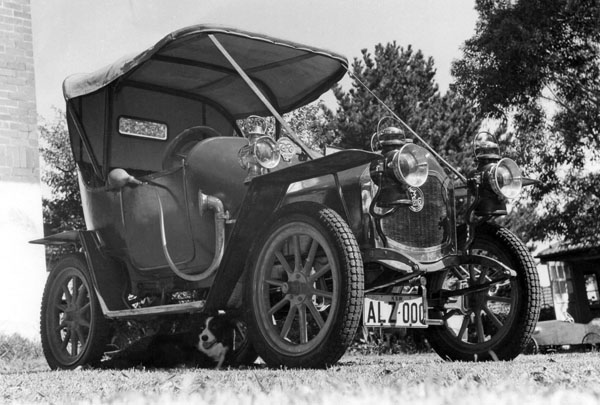
1908 Le Zebre
Beautifully proportioned, the French Le Zebre was an inspired design which appeared long before baby cars were a recognised fact. With a wheelbase of 1829 mm (6 ft) and an overall length of 2718 mm (less than 9 ft), she was appreciably smaller than the original Mini Minor.
When Le Zebre appeared in 1908, car designers were experimenting with every conceivable chassis layout, often placing the components where they would fit.
By chance, or by foresight, Le Zebre chose a layout which today would be considered conventional. The 600 cc single cylinder engine developed 4 horsepower at 1200 rpm.
The back axle and differential were shaft driven by a two speed gearbox, the driver having a choice between a 3 to 1 ratio in bottom gear or 1 to 1 in top.
With the engine running at full speed, Le Zebre could reach a maximum speed of 43 km/h (27 mph).
Technical features included thermosyphen cooling, multiplate wet clutch and two wheel drum brakes.
The company continued to make cars, at a factory close to Renault in Paris, until 1931.



This was restored in mid to late 1950s by my late father, Barry Perdriau. I was very fortunate to drive it once. I recall the Sydney to Blue Mountains rally when I was a passenger as a child – my mother was at the wheel and father behind it, pushing it up a hill. That may have been at Kurrajong, from memory.
The photo looks to have been taken in the backyard of my grandfather’s place and the ALZ000 plates borrowed from one of our other cars. In the background, there is what appears to be the chassis of a “toy” car my grandfather made that we used to drive around a local paddock.