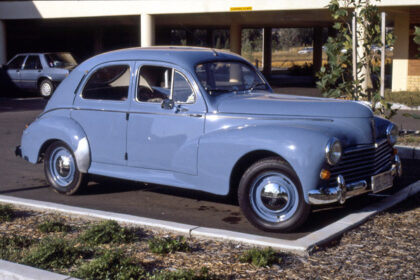
PEUGEOT 203

During World War II Peugeot had been planning a new post-war model, and was able to introduce the new 203 as early as the autumn of 1947. It was a sensationally modern car with a streamlined unitary body and a new four-cylinder 1290 cc engine. Although it would continue to be manufactured for many more years, its replacement had already appeared in 1955: the Peugeot 403. After sampling such unusually heady vintages you might think that the postwar 203 would seem distinctly vin ordinaire. Not so! While it is undoubtedly… Read more
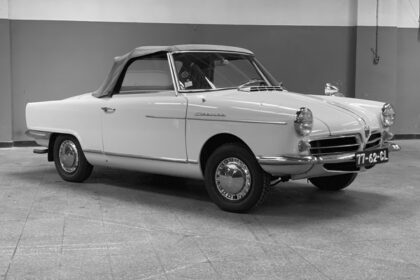
NSU WANKEL SPIDER

The NSU Wankel Spider was the first car to be powered by the Wankel rotary engine. A rotary engine uses an internal shaft with lobes that form combustion chambers and in that layout combines the principles of the turbine and the piston. This engine was invented by Dr Felix Wankel. He intended it to be an answer to the perceived inefficiencies of the piston engine. Dr Wankel felt that the direct rotary action as a driving force for cars was one step up from imparted rotary action, as is the… Read more

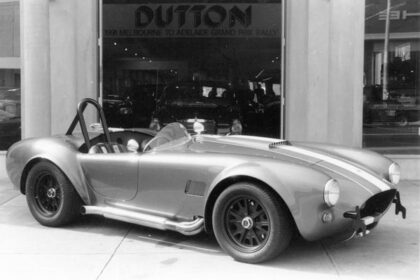
AC COBRA

The AC Cobra was a high-performance cross breed; a British AC Ace with a Ford V8 engine. The first 75 production cars used the Ford 4.2-litre engine but this was then replaced by the 4.7-litre V8 from the Ford Mustang. Only 560 of these 4.7-litre Cobras were built in the mid-1960s. In standard form it provided 202 kW but it was possible to buy a race-tuned version which turned out a mighty 276 kW. Right from the commencement of the project, AC shipped cars to California without engines or transmissions…. Read more

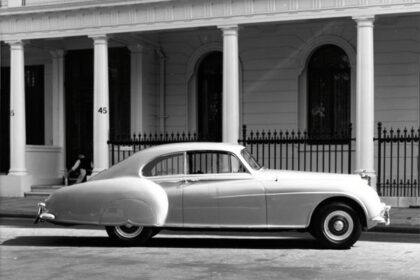
BENTLEY CONTINENTAL

The Bentley Continental has been described as one of the most attractive and refined motor vehicles ever built and when introduced in 1952 was the world’s fastest saloon. The Bentley was perceived by many as a Rolls-Royce with a different radiator grille and badges yet the manufacturers insisted on promoting it as `The Silent Sports Car’. Silent it might have been but it was far from being a sports car. To improve performance the Bentley Continental had a weight reduction from 1860kg to 1650kg and a change in gear ratios… Read more

AUBURN SPEEDSTER

The name Errett Lobban Cord is inextricably tied up with American motoring of the 1920s and 1930s. Cord was a Californian car salesman who was also good at selling himself. The Auburn Automobile Company was struggling to survive in 1924 when they came in contact with Cord. Auburn had established a reputation for producing cars which cost less but looked to go faster than their rivals. In some ways they were considered classics of the con man’s art, a situation which suited Cord perfectly. Anyway Auburn were left with a… Read more

TUCKER TORPEDO

In the eyes of Preston F. Tucker, the American car of just after the end of World War II was totally out-of-date. Most car buyers at that time saw the Buick straight-eight – a large, heavy and conservative model – as the car they aspired to owning. With his 1947 Torpedo, Tucker offered a rear-mounted, flat-six engine with hydraulic valve actuation, sealed cooling system, torque converter-transmission, all-independent suspension and disc brakes. He also included special in-built safety features such as pop-out windscreen, crash padding and break-away mirror – a good… Read more

PEUGEOT 202

In 1929 Peugeot introduced the nomenclature comprising a three-digit number with a central 0, rather than using a name when they launched the 201. In this trademark registered numbering system all numbers between 101 and 909 are covered with the first number representing the size of the car and the last number indicating its chronological position. You can imagine the red faces at Porsche when they applied to register their model 901 in 1963 and had to make a quick change and call it model 911. Although the Peugeot 202… Read more

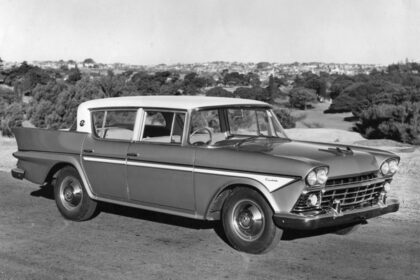
NASH RAMBLER

The Rambler marque was first used by the Thomas Jeffery Company between the years 1900 and 1914. The successor of this Company, Nash Motors reintroduced it from 1950 to 1954. After Nash was acquired by the American Motors Corporation the Rambler marque was again used from 1954 to 1969. When developing this new car, Nash had originally intended to call it the Diplomat as this name would have gone well with their other model names, Statesman and Ambassador. When they found out that Dodge had already reserved the Diplomat name… Read more

VOLVO P1800T

1964 Volvo 1800

The Volvo P1800 was shown publicly for the first time at the Brussels Salon in January 1960. Although nobody was surprised that Volvo had once more decided to produce a sports car, the `un-Swedish’ lines were something of a surprise. One of the most popular accessories were the spoked wheels which were fitted using the ordinary wheel nuts and looked the real thing. A new 75 kW B18B engine gave the car excellent performance and proved to be an extremely hard wearing sports car engine. Volvo was careful to point… Read more

VOLVO P1800T

1964 Volvo 1800

The Volvo P1800 was shown publicly for the first time at the Brussels Salon in January 1960. Although nobody was surprised that Volvo had once more decided to produce a sports car, the `un-Swedish’ lines were something of a surprise. One of the most popular accessories were the spoked wheels which were fitted using the ordinary wheel nuts and looked the real thing. A new 75 kW B18B engine gave the car excellent performance and proved to be an extremely hard wearing sports car engine. Volvo was careful to point… Read more