TRIUMPH HERALD

Released in 1959 the Triumph Herald was one of the most significant Triumphs of the post-World War II years. It changed the marque’s image with the motoring public being the first of a new generation of mass-produced saloons. However, a number of problems had to be overcome before the Herald became a reality. The manufacturer, Standard, being the smallest of Britain’s motor car manufacturers, had to rely on outside suppliers for many components including mass-produced bodywork but the supplier of Vanguard and Mayflower bodies was bought up by BMC after… Read more
BMW 502

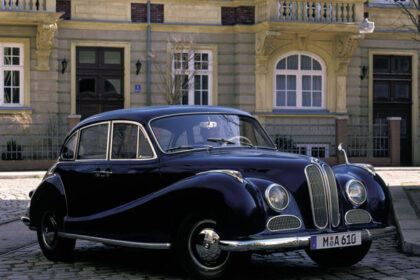
In July 1954 Germany’s first post-WWII car and BMW’s first V8 car – the 502 – was introduced. In using the same body as the 501, at first it was only recognisable from the outside by its extra chrome trim below the belt line, a V8 emblem on the boot lid and built-in foglights in its lower front guards. In late 1955 it got a wraparound rear window, but several months before this the 501 came out also with a V8 engine, no side chrome strips and a smaller rear… Read more

SUNBEAM TIGER

The four-cylinder Sunbeam Alpine had a very attractive open body and sold well right from its initial release by the Rootes Group in 1959. No doubt motivated by the success of the AC Cobra, discussions were held with American Carroll Shelby, who set about to carry out initial engineering to allow the fitting of a V8 engine to the Alpine body. After the initial considerations Rootes’ engineers took over and out came the four-cylinder 1592 cc engine and in its place went a Ford V8 of 4.2 litres. To couple… Read more

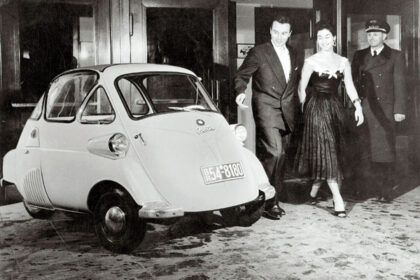
BMW ISETTA

On first sighting most BMW owners would probably never believe that a car of this design carried the famous logo of this marque. Perhaps on reflection they may realise that BMW is also famous for its range of motorcycles and hence could understand that such a vehicle could have come from Bayerische Motoren Werke of Germany. Originally designed in Italy where the concept found little interest it later became one of the most successful mini-cars in postwar Germany. It was powered by a 247cc BMW motorcycle engine and first built… Read more

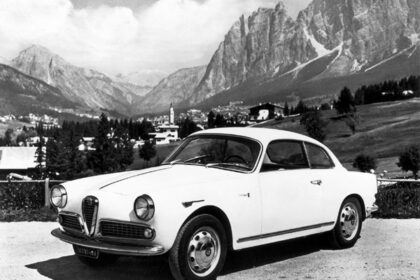
ALFA ROMEO GIULIETTA SPRINT COUPE

The Alfa Romeo Sprint Coupe came onto the market in 1954 as a replacement for Alfa’s first postwar production design, the 1900, which had been released in 1950. Prior to the 1950s, cars were a relatively small part of Alfa Romeo’s business, its main business being the manufacture of aircraft engines. In the 1920s and 1930s Alfa Romeo competed in many car races and were successful in Grands Prix, Mille Miglia and Le Mans on a number of occasions, soon gaining a reputation as the outstanding marque for the inter-war… Read more

PIONEER

The kerosene-fuelled Pioneer was once heralded by the press as ‘Australia’s First Horseless Carriage’. If was launched with great zeal and photographs were published around the world. The Pioneer had its beginnings when Henry Austin, an amateur inventor from Fitzroy, Victoria, designed a lightweight, petrol-fuelled engine. He wanted to follow it up by building a complete vehicle and 20 local businessmen formed the Australian Horseless Carriage Syndicate to back him, Austin, however, withdrew from the project when the Syndicate pressured him to have the vehicle ready for exhibition at the… Read more

MASERATI MERAK

Although first displayed at the Geneva Auto Show in 1975 the Merak didn?t actually go into production until 1980. It was discontinued in 1983 after 1832 units marque were produced. At the time it became Maserati’s best-selling model. Merak was based on the Bora, Maserati’s first mid-engined car which had a very distinctive all-steel body by ItalDesign and was produced between 1971 and 1980. The Merak used not only the Citroen’s complex hydraulics and underpinnings but also some body panels from the Bora. From the front it was almost impossible… Read more

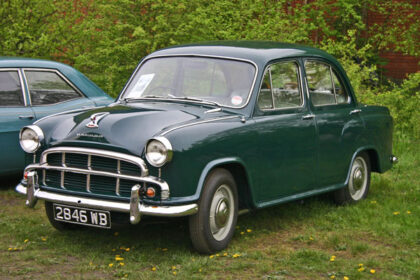
MORRIS OXFORD SERIES II

The Morris Oxford Series II was powered by a 1489 cc four-cylinder BMC overhead-valve engine which developed approximately 37 kW. It had a three-bearing crankshaft with a renewable element external oil filter. Whilst the manufacturer rated the performance as exciting – with power, flexibility and astonishing fuel economy when it was released as a medium sized sedan – compared with today’s baby cars it was a very poor performer. One of its best attributes was the body, especially the wide door openings that gave direct access to the seats. Efficient… Read more

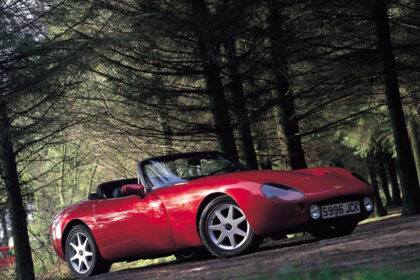
TVR GRIFFITH

The TVR Griffith is, in many ways, similar to the Porsche Boxster. Whilst it was not the steel-bodied sophisticate, with monocoque body powered by a multi-valve, mid-engined marvel of German engineering this automobile from Blackpool made up in force what it lacked in technology. It had a tubular chassis with a body of plastic and many recognised that the final car was quite phenomenal. The Griffith was the first of a new generation of TVRs and the one that did more than any other to advance the image from one… Read more

PORSCHE 959

The late 1980s heralded in an economic boom in Western Europe and, amongst others, sportscar makers at the top end of the market saw the opportunity to exploit it ruthlessly with hugely expensive limited editions. The Porsche 959 was the first of these super performers and set the standard for imitators. Aston Martin in Britain produced the Vantage Zagato, while Ferrari made small numbers of its 288GTO in 1986 and its 322km/h F40 in 1987. Their success persuaded other manufacturers to follow suit. Within three years, Jaguar had announced its… Read more