Toyota says the new Prado delivers comprehensive improvements in driveability, off-
road capability, safety, technology and functionality — all wrapped in a bold, stylish
redesign that will appeal to urban families and off-road adventurers alike.
We’ve spent a lot of time in the previous Prado clocking up thousands of kilometres
in Outback Western Australia.
With four adults and their luggage, it was a bit of a squeeze at times and I would
have loved to remove the two intrusive, fold-down third row seats to free up space.
The focus for designers this time around, according to Mr Toyoda himself, was
“practicality, durability and dependability”. Correct us if we are wrong, but that has
always been the focus.
What’s changed?
STYLING
Ten years ago prices for the Prado started from $56,090; the Kakadu from $85,900.
Fast forward and Prado now comes in five grades, kicking off with the bare bones
GX from $73,200.
GXL is priced from $79,690 (five-seat) or $80,690 (seven-seat), VX from $88,100
(seven-seat), Altitude $90,340 (five-seat) and top of the range Kakadu from
$100,690 (seven-seat).
Bear in mind that on-road costs still have to be added to theses prices.
The three-figure sum for the Kakadu is quite frankly outrageous, putting it well
beyond the reach of most families — those that live in Sydney’s west anyway.
The rest? Over on the North Shore most of them don’t aspire to own a Toyota. They
want a Land Rover or one of the German brands, which leaves us wondering who
will buy the new Prado.
All grades of the Prado are powered by the same diesel-electric hybrid and all come
with an automatic.
There’s eight exterior colours. Premium paint adds $675 while a two-tone paint job is
$1675.

Entry-level GX comes with five seats, fabric upholstery, dual-zone climate control,
manually adjustment for seats, smart entry and start, LED headlights, all-speed
adaptive cruise control, rain-sensing wipers, front and rear parking sensors, 7.0-inch
digital instrument cluster, panoramic view monitor and 10-speaker audio.
GXL adds a third row of seats and synthetic leather, heated and cooled front seats
with power-adjust driver seat, leather-accented steering wheel and shift lever, rear
aircon controls, auto-dimming rearview mirror, heated and power-fold side mirrors
and a powered tailgate.
VX steps up to 20-inch alloys, a black vertical grille with the Toyota bullhorn logo,
body-coloured bumpers and wheel arches.
There’s also LED headlights with auto high beam, leather-accented upholstery,
driver lumbar and seat memory, four-way power adjustable front passenger seat,
power-adjustable steering wheel, refrigerated centre console box, a larger 12.3-inch
digital instrument cluster, multi-terrain monitor and 14-speaker JBL premium audio.
Kakadu adds 20-inch wheels, heated and ventilated rear seats, manually-adjustable
driver seat cushion length, illuminated side steps, and a limited slip diff.
It also scores head-up display, a digital rear view mirror, heated steering wheel and
tilt and slide panoramic sunroof.
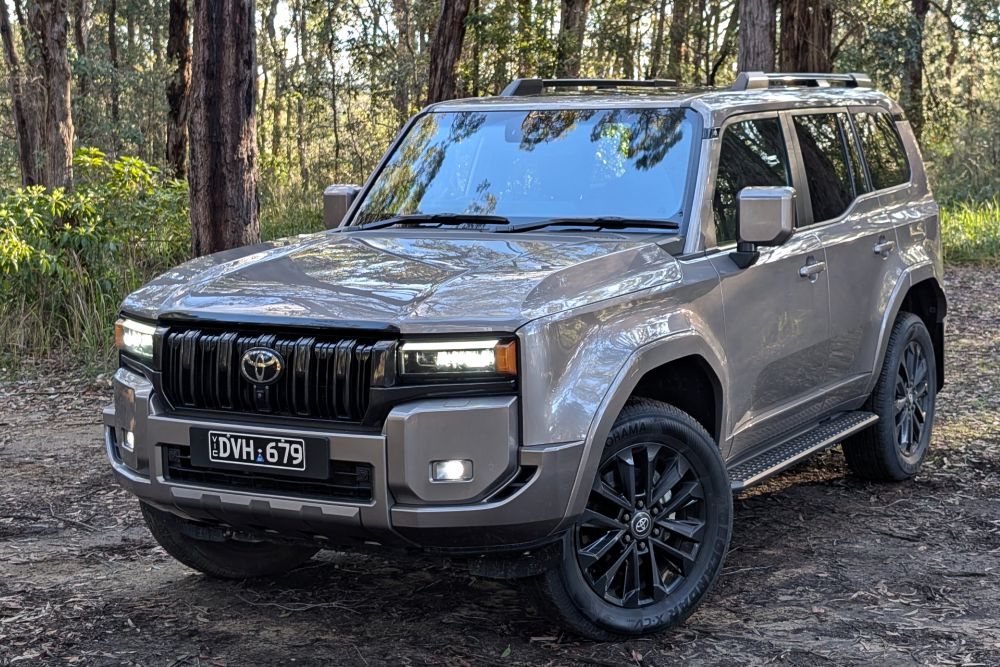
Our test vehicle this time was top of the range, seven-seat Kakadu.
Prado is covered by a 5-year warranty unlimited kilometre, with 5-year/100,00km
capped price servicing, pegged at $390 per visit with intervals of six months or
10,000km.
INFOTAINMENT
Multimedia across the lineup comes in the form of a 12.3-inch multimedia system
with Bluetooth, wireless Apple CarPlay and Android Auto, built-in satellite navigation
with cloud function, AM/FM/DAB+ radio, Toyota Connected Services and a 10- or
14-speaker audio system.
There are six USB-C charging ports, one 12V accessory port and a 220V charging
port, plus a wireless charging pad.

Access to connected services is complimentary for 12 months.
SAFETY
With nine airbags Prado has been awarded a full five stars for crash safety, with the
latest generation suite of Toyota Safety Sense active safety technologies, along with
Toyota Connected Services.
Driver-assist features are designed to work on- and off-road, with an improved
camera and radar system that is able to scan the road with greater accuracy and
over greater distances.
Systems include the autonomous emergency braking pre-collision safety (PCS)
system, rear parking support brake, lane trace assist and lane departure warning,
road sign assist, blind spot monitor with safe exit assist, emergency driving stop
system and a driver monitor camera.
A full-size spare is sequestered under the rear.
ENGINES / TRANSMISSIONS
All variants are powered by the same hybrid 2.8-litre turbo-diesel drivetrain, together
with full-time four-wheel drive and an eight-speed automatic transmission.
It’s the same diesel as used in Hilux and develops 150kW of power from 3000-3400
rpm and 500Nm of torque from 1600-2800 rpm (same outputs as before).
But new Prado is heavier than the old Prado and the power to weight ratio is worse,
which means it won’t be as quick.
DRIVING
Prado sits on the same GA-F platform as its larger sibling the Land Cruiser 300
Series.
It’s 30 per cent stronger than before and it also means the ‘all-new’ Prado is larger,
inside and out.
The figures show it’s 16.5cm longer and 9.5cm wider, with a 6.0cm longer wheelbase
plus wider front and rear tracks (distance between wheels).
Access to the third row seats is via the single, passenger side second row seat that
folds and tumbles to make way.
When not required the third row seats fold flat, but not into the floor because there’s
not enough room down there with the hybrid battery and spare sitting under the rear.
With all seats upright there’s 182 litres of luggage capacity, with the third row stowed
906 litres and with both second and third row seats not in use 1829 litres.
The previous model offered 120, 620 and 1833 litres respectively.
We’re surprised by the second figure. Maybe the way they measure it has changed,
because despite the figures it feels like there’s less space with the third row folded —
much less useable space anyway.
Only the seat backs fold leaving an awkward space between the end of the seat
base and the tailgate that Toyota has filled with a cheap felt-topped detachable
storage box.
If we were handing over $100K, we’d expect something better, something that
reinforces the Kakadu’s status as a luxury model — not this piece of crap.
There’s also the problem of what to do with the privacy screen with the third row in
use — there’s nowhere to put it.
We previously tested the five-seat version of the vehicle which also has an elevated
luggage floor.
However, the problematic third row in the seven-seater is a deal breaker, as far as
we’re concerned.
Moving on to the rest of the cabin, the dash has been flattened, with an upright,
squared off design, and clearly defined separation between driver and infotainment
screens.
The flat Beetle-esque design has presumably been adopted to create more cabin
space.
Aircon gets its own space tucked under the centre screen. Physical aircon and
media volume controls are available, with buttons for transfer, drive modes and off-
road settings grouped around the transmission lever.
Electric power steering promises easier handling off-road, with improved
manoeuvrability at low speed — plus it permits lane trace assistance to be
introduced.
Maximum approach and departure angles are 32 degrees and 17 degrees
respectively, with a break-over angle of 25 degrees.
Ground clearance is 221mm (210mm for the GX and GXL), compared with the
220mm of the previous model and it has a wading depth of 700mm.
The 48-volt “V-Active” mild hybrid system that made its debut last year in Hilux, with
a lithium-ion battery and electric motor to capture energy normally lost through
braking.
It contributes a mere 8.4kW and 65Nm to the equation and is unlikely to be
responsible for saving much fuel.
With auto engine stop-start and an eight-speed replacing the six-speed transmission,
however, the wider spread of gear ratios will extract better performance from the
drivetrain and contribute to better fuel economy.
A higher final drive ratio delivers a more relaxed driving experience at cruising
speeds.
The end result is that claimed fuel consumption is down from 7.9 to 7.6L/100km.
Be that as it may, we were getting 9.2L/100km after more tan 750km of mixed
driving. A significant difference.
Of note that’s exactly the same result as the 9.2L we got from the non-hybrid Kakadu
we drove back in 2022.
Also down is maximum fuel capacity, which was 150 litres before if you elected to
put the spare wheel on the tailgate.
The new one sees the spare located underneath and a capacity of 110 litres across
the board.
This translates to about 520km less in range and is a big negative when it comes to
getting off the beaten track.
You’ll need to top it up occasionally with AdBlue too, with the addition of a 17-litre
tank to reduce harmful engine emissions.
On this point, our test vehicle started to continually flash warnings that it needed to
be topped up — get this — in 2500km.
Nothing like getting in early. WTF?
The move to the larger 300 Series platform sees Prado’s tow rating increase from
3000 to a more respectable industry-standard 3500kg.
Kakadu has a full-time four-wheel drive system, with low-range gearing and a rear
Torsen limited slip diff (not all grades get this).
During normal straight line driving power is split 40:60 front-to-back.
Only VX and Kakadu are equipped with the variable suspension system.
There’s five drive modes, together with multi-terrain select and a multi-terrain monitor
which provides a comprehensive view of the vehicle’s underfloor and surrounds
when off-road.
Other driver assistance systems for on and off-road environments include vehicle
stability control with active traction control, downhill assist control and crawl control.
Trailer sway control and a pre-installed wiring harness help facilitate the increased
3500kg braked tow capacity.
Sure the ‘all-new’ Prado looks and drives better than the old one, and it would want
to given the price.
With a lower centre of gravity and slightly lower ride height, the ride is noticeably less
jiggly and there is less body roll in corners.
But in typical diesel fashion you still need to wind the thing up.
The cabin does not have the premium feel of the previous generation Kakadu nor do
the front seats feel as spacious as before.
In fact, describing the experience to a punter we realised it feels very like the Hilux
from behind the wheel.
That wheel by the way is the same as the steering wheel in Hilux as is the
transmission level — the two points of most contact.
On a final note, once again you can’t see the head-up display with polarised
sunglasses and for those with multi-focal glasses, the digital rear vision mirror is a
waste of space.
To bring the image into focus you need to look towards the roof to access the lower
section of the lenses.
The one time we tried switching to the digital image, it was worse than the standard
view because water was blocking the camera lens.
The best laid plans.
SUMMING UP
Buyers are being asked to pay an awful lot of money for a car that arguably doesn’t
deliver a whole lot more, perhaps even less than before.
The designers really need to go back and rethink the third row, because as it is the
seats take up an enormous amount of room when folded.
Toyota has filled the gap between the base and the tailgate with a silly, tacky plastic
box which does not offer much utility, all in the name of a flat floor — or should we
say elevated flat floor.
That is to say for a large four-wheel drive the Prado does not offer much luggage
space — how can that be seen as practical Mr Toyoda.
The driver’s seat feels tight too, more like the Hilux than a luxury off-roader.
If you’re not interested in going off road the Kluger makes more sense.
It’s much more comfortable and suited to city driving.
RATINGS:
Looks: 7.5
Performance: 7.5
Safety: 8
Thirst: 7
Practicality: 6
Comfort: 7
Tech: 8
Value: 6
Overall: 7.1
AT A GLANCE
MODEL LINE-UP
Prado GX 7-seat $73,200
Prado GXL 5-seat $79,690
Prado GXL 7-seat $80,690
Prado VX 7-seat $88,100
Prado Altitude 5-seat $90,340
Prado Kakadu 7-seat $100,690
Options: Premium paint $675 (plus two tone, Altitude only, $1675)
Note: These prices do not include government or dealer delivery charges. Contact
your local Toyota dealer for drive-away prices.
SPECIFICATIONS (Toyota Prado Kakadu 2.8L 4-cylinder turbocharged diesel, 8sp
automatic, full-time AWD)
ENGINE:
Capacity: 2.8 litres
Configuration: Four cylinders inline
Maximum Power: 150kW @ 3000-3400 rpm
Maximum Torque: 500Nm @ 1600-2800 rpm
Fuel Type: Diesel
Combined Fuel Cycle (ADR 81/02): 7.6 L/100km
Emissions CO2: 200 g/km
V-Active drive: Electric motor, 48V 8kW / 65Nm
Battery: Lithium-ion, capacity 4.3Ahr
DRIVELINE: Eight-speed, dual-range transfer case, centre lockable limited-slip diff,
all-wheel drive
DIMENSIONS, WEIGHT, AND CAPACITIES
Length: 4990 mm
Width: 1980 mm
Height: 1935 mm
Wheelbase: 2850 mm
Kerb weight: 2595 kg
Turning circle: 12.8 m
Fuel Tank Capacity: Diesel 110 l (AdBlue 17.4 l)
BRAKES
Front: Ventilated disc
Rear: Ventilated disc
STANDARD WARRANTY
5 years / unlimited kilometres