Another car maker has come forward with a fully electric delivery van.
The Chinese V7E comes from Geely’s commercial arm Farizon, but will be distributed by Jameel Motors Australia.
Geely’s other brands include Volvo, Polestar, Lotus, Zeekr, Smart and of course Geely Auto itself.
V7E is reportedly designed for high-frequency city deliveries, targeted at couriers, city fleets and businesses.
It will compete with the likes of LDV eDeliver 7 and 9, Mercedes‑Benz eVito, Peugeot e‑Expert, Ford E‑Transit and the Renault Master E‑Tech.
With 6.95 cu m of cargo volume, a payload capacity of 1338kg and load length of 2860mm, the V7E has a claimed range of 329km when fully charged.
But Farizon is yet to disclose details of the electric motor, the capacity of the CATL LFP battery or how long it takes to charge.
That will happen closer to launch.
You can however register your interest in buying the van.
Geely or is it Farizon or Jameel Motors says this marks the expansion of its Australian commercial vehicle lineup with a built-for-business model engineered to meet the realities of urban delivery and commercial operations.
Aimed at price-conscious couriers, contractors, sole traders and fleet operators, particularly those reassessing the true cost of their next work vehicle, V7E has been developed with a clear focus on work-rate, durability and value.
Its narrow, agile body, efficient footprint and tight turning circle make it well-suited to high-frequency routes, loading zones and job-site access, while its lightweight, responsive design supports efficient movement through congested metro environments.
The van has been engineered around how light commercial vehicles are actually used: frequent stops, tight access, daily loading and high utilisation.
Like the Farizon SV range, the V7E benefits from a suite of modern safety, comfort and connectivity features designed for everyday commercial use, including comprehensive driver assistance systems, advanced connectivity with smartphone integration, and modern safety technology engineered to support driver confidence and daily productivity.
Farizon says the V7E enters the Australian market at a time when many operators are reassessing rising fuel, servicing and operating costs, alongside the introduction of more sustainable processes.
By removing fuel dependency and reducing mechanical complexity, the V7E offers a compelling alternative for businesses looking to lower ongoing costs without changing how they work.
Electric power is positioned as a practical advantage rather than the headline, delivering quiet operation, simplified charging at home or depot, and fewer service components compared with traditional ICE vans.
“Many operators are reassessing the true cost of running traditional ICE vans and looking for alternatives that do not require a change in how they work,” Jameel’s Adam Lawson said.
“The V7E delivers the payload and usability businesses expect from a light commercial vehicle, while offering the potential for lower ongoing costs and simplified ownership over time.”
Complete vehicle specifications, variant details and pricing will be officially announced in April 2026, with the V7E available for delivery from May 2026.
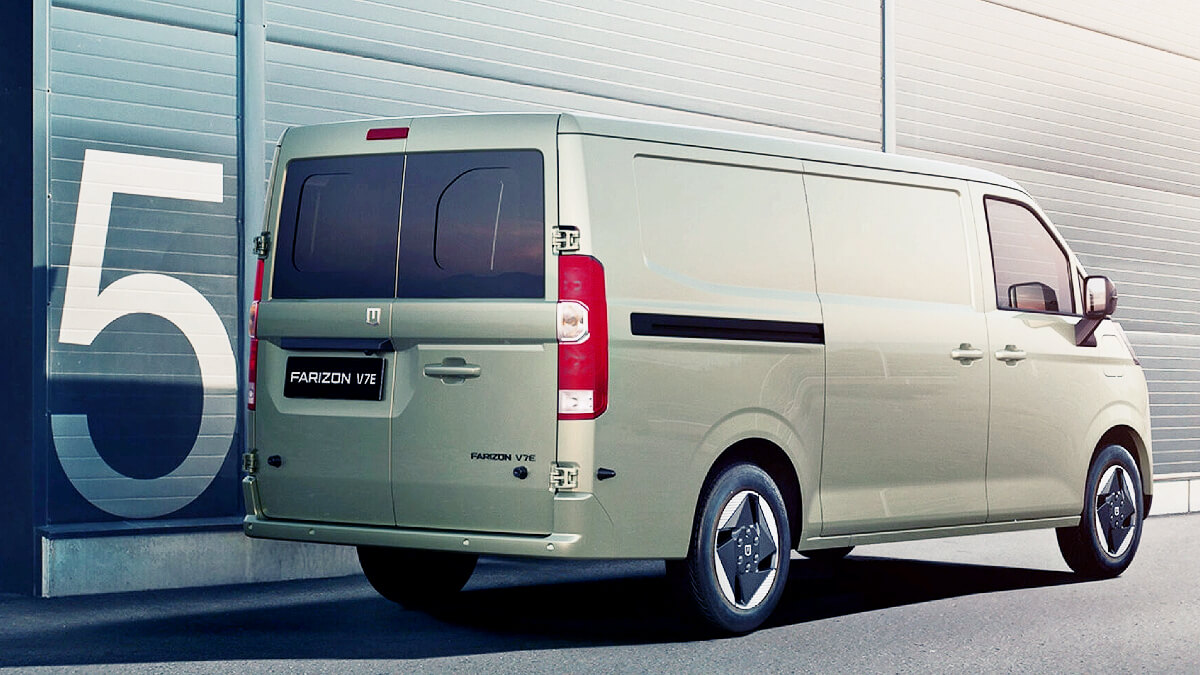
Farizon V7E electric van
CHECKOUT: Geely Starray: Beam me up!
CHECKOUT: Geely EX2 a blip on the radar