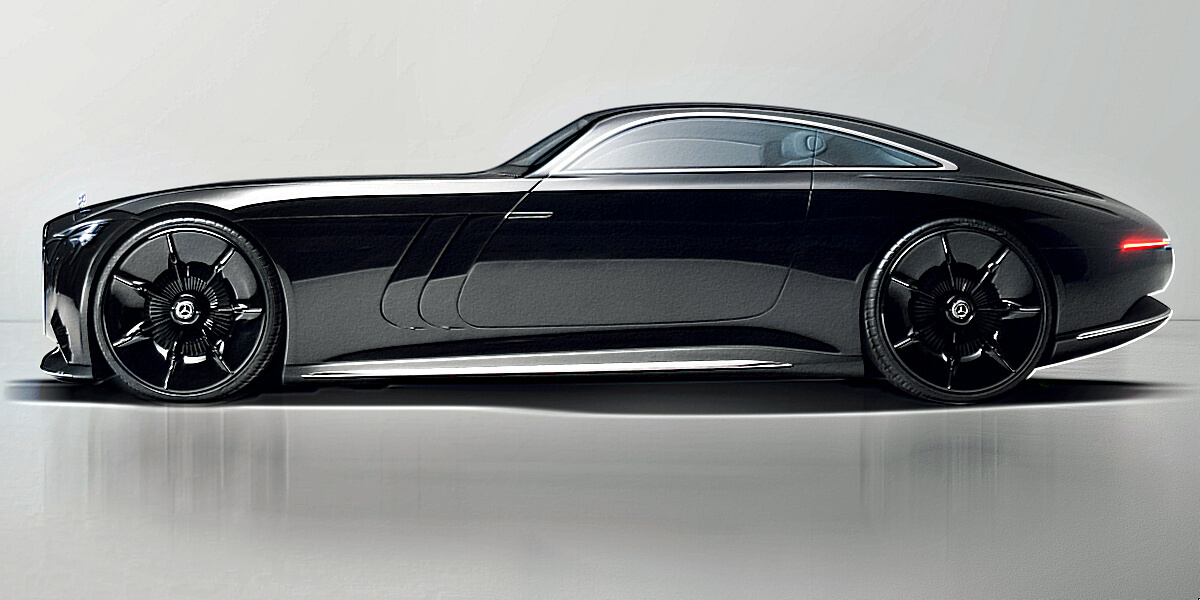
The Mercedes-Benz Vision Iconic concept car previews the look and technology that will be carried forward by models.
The stylised grille has been a key design element of Mercedes-Benz vehicles for more than 100 years and has been reinterpreted for this show car.
Introduced with the all-new electric GLC in September, Benz says the new grille enables its cars to stand out from the sea of sameness.
The iconic grille draws inspiration from the upright grilles of legendary models such as the W 108, W 111 and the Mercedes- Benz 600 Pullman.
Vision Iconic builds on this strong presence by even illuminating the upright star on the bonnet.
With the roll out of automated driving, Benz says the role of the car’s interior is evolving.
Vision Iconic offers a glimpse into this future, characterised by lounge-like comfort and an entirely new experience of hyper-analogue and digital luxury.
The interior of Vision Iconic redefines automotive elegance through an opulent Art Deco-inspired composition of finest craftsmanship and exclusive materials.
The centrepiece of the instrument panel is a floating glass structure called “Zeppelin”.
form that reveals a captivating interior of artfully designed details and a refined interplay of analogue and digital instruments.
As the door is opened, the instrument cluster comes to life with a cinematic, entirely analogue animation inspired by high-end chronographs.
At the centre, one of the four clocks is shaped like the brand logo, acting as an AI companion.
Behind the Zeppelin, a generous decorative surface unfolds into a breathtaking inlay of lustrous mother-of- pearl look, offering both visual depth and artisanal finesse.
In front of the driver the four spoke steering wheel highlights a sporty yet elegant character, with the Mercedes- Benz logo floating inside a glass sphere, clasped by the spokes like a jewel.
Mercedes-Benz is also researching innovative solar cells that could be seamlessly applied to the bodywork of electric vehicles, similar to a wafer-thin paste.
An area of 11 sq m (equivalent to the surface of a mid-size SUV) could produce energy for up to 12,000km a year under ideal conditions.
The solar cells generate energy continuously – even when the vehicle is switched off.
With its research into artificial neural networks, Mercedes-Benz is breaking new ground in the development of computer architectures together with partners from research and industry.
Neuromorphic computing mimics the human brain and could make AI calculations significantly more energy-efficient and faster.
Safety systems, for example, could better recognise traffic signs, lanes, and other road users and react faster, even in poor visibility conditions – and would be 10 times more efficient than current systems.
Ben says neuromorphic computing has the potential to reduce the energy requirements for data processing in autonomous driving by 90 percent compared to today’s systems.
CHECKOUT: Merc 300SL and 190SL: 70 years of style
CHECKOUT: Mercedes-Maybach EQS 680 — luxury meets ultra luxury