Audi is scaling up the integration of Artificial Intelligence (AI) into large-scale series production .
For example, in German assembly plants, workers are increasingly being controlled centrally from the cloud.
They receive information such as vehicles’ specifications or regional versions from a central source in real time.
The move to the cloud has already eliminated the need for more than 1000 industrial PCs (no word on its workforce yet).
In doing so, the company is setting the next benchmark in fully networked factory automation and at the same time laying the foundation for the widespread use of AI in production.
“Artificial intelligence is a quantum leap for efficiency in our production,” Member of the Board of Management for Production and Logistics, Gerd Walker, said.
“With our AI and digitalisation roadmap, we are transforming our plants into smart factories where AI acts as a partner, providing our employees with tailored support.
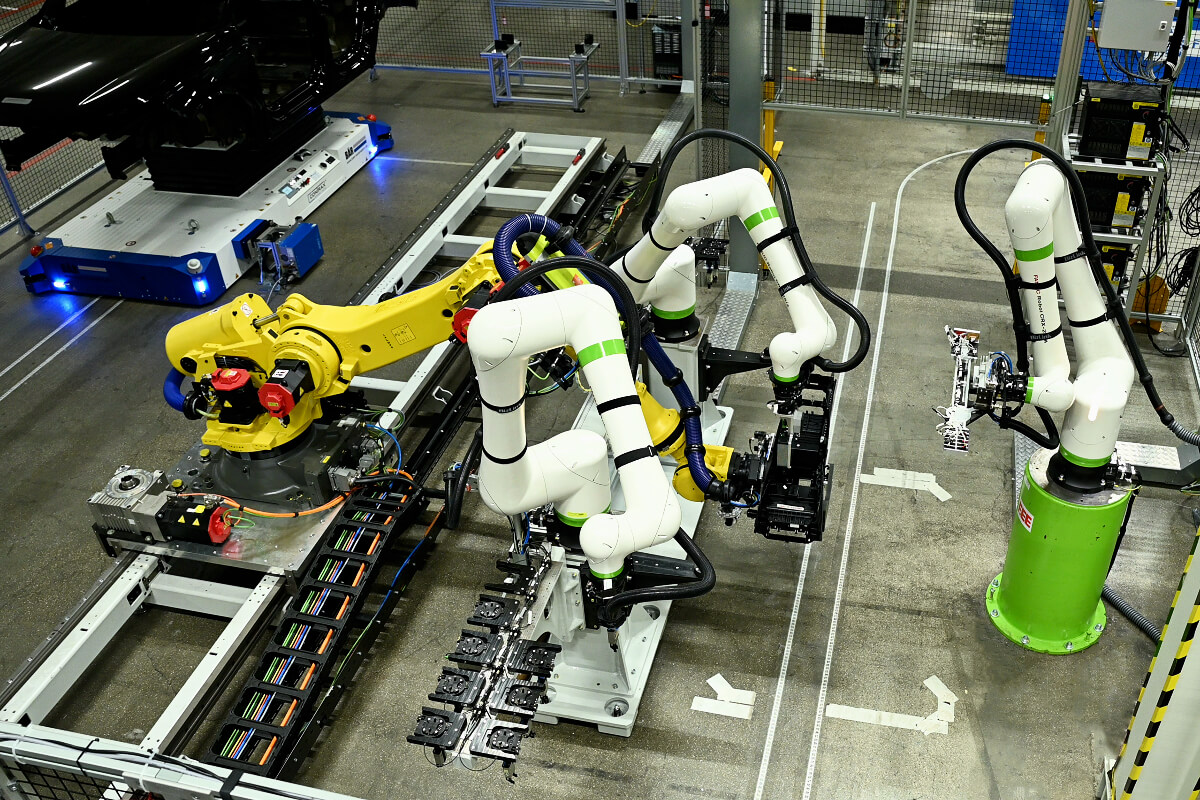
“The first AI-controlled robots are taking over tasks that are ergonomically strenuous, and chatbots are providing additional relief.
“We are bringing together Audi’s decades of production expertise, our own innovative strength, and the expertise of strong partners such as the Innovation Park Artificial Intelligence (IPAI) in Heilbronn.”
Edge Cloud 4 Production (EC4P) provides the basis for the transformation.
The introduction of AI makes it possible to combine conventional automation with flexibility and computing power from the cloud.
This allows Audi to simplify processes, reduce the amount of hardware required, and introduce new functions more quickly.
That makes processes more stable, reduces maintenance costs, and increases IT security.
In the body shop for the A5 and A6 series in Neckarsulm, Germany, EC4P is now being used in a highly automated production environment for large-scale series production for the first time.
Virtual programmable logic controllers (vPLC) are replacing local hardware controllers on the production lines.
Industrial devices, including around 100 robots, work together via the EC4P with millisecond precision.
EC4P meets the highest requirements for a smooth production process, enabling several hundred vehicle bodies to be manufactured every day in three shifts – a benchmark that is unique in the industry to date.
The Weld Splatter Detection (WSD) system will also run on the EC4P in the future, enabling even greater flexibility and scalability.
It detects weld splatter on the underbody and thanks to a recent upgrade, a robot arm has taken over the physically demanding chore of grinding them down.
In the Next2OEM project, Audi is working with 10 partners at its Ingolstadt headquarters to demonstrate how the production and assembly of a wiring loom can be completely digitised and automated – from the supplier to installation in the factory.
To date, less than 10 percent of wiring loom production and assembly is automated across the industry.
The benefits are considerable: less logistical effort and significantly shorter lead times for changes – minutes instead of weeks.
The next step is to incorporate the knowledge gained into the large-scale production of future vehicle projects.
In its Code of Conduct, which is binding for all employees, and in a policy statement on artificial intelligence, Audi is committed to the responsible use of AI as a key technology of our time.
The three guiding principles of respect, security, and transparency are intended to help exploit the potential of AI, protect the company and its employees, and respect the rights of users.
In addition, the Data Sharing Code of Practice ensures that data is handled in accordance with the company’s values.
CHECKOUT: Audi SQ8: Good as gold
CHECKOUT: Porsche magic turned Benz and Audis into bahnstormers