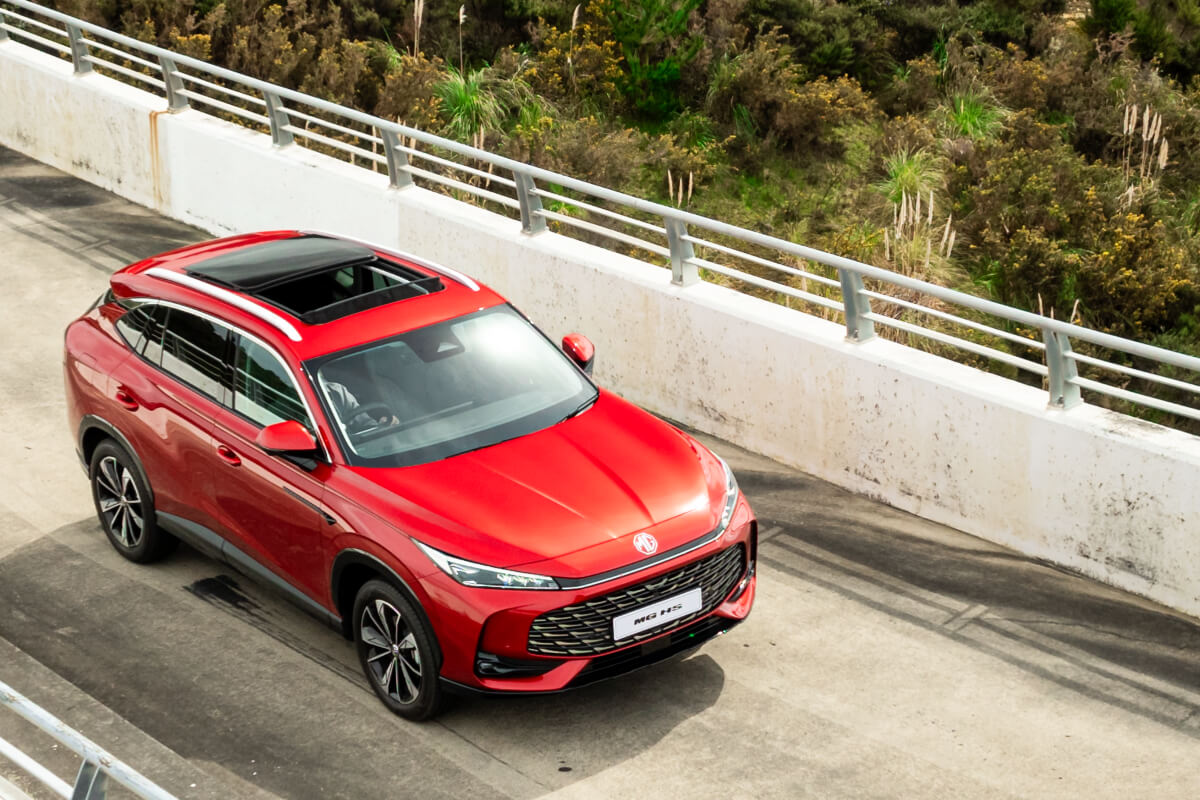
It’s over three years since we first drove what was then called the MG HS +EV, or
plug-in hybrid as they have come to be known.
And haven’t things changed in this time? Not only has the car grown in size, so has
the battery and projected, electric-only driving range.
Now in its second generation, the HS has emerged from its cocoon, spread its wings
and become a fully-fledged “Super Hybrid” — it’s a much more enticing proposition.
STYLING
There are two grades from which to choose, Excite and Essence.
Prices start from $42,990 for the Excite and $46,900 for the Essence – both prices
driveaway.
Our test vehicle, Essence, was finished in Arctic Blue Metallic, with Classic Tan
interior trim — they add $700 apiece.
Standard kit includes cloth trim and auto air conditioning with rear outlets, along with
18-inch alloys, keyless entry and start, LED lights front and back, power-adjust driver
seat, head-up display, auto high beam, adaptive cruise control, traffic sign
recognition, auto lights and wipers, rear parking sensors and six-speaker audio.
Essence adds larger 19-inch alloys, artificial leather, dual zone climate air, electric
tailgate, panoramic sunroof, front parking sensors, eight-speaker audio, 360-degree
camera and wireless phone charging.
There’s also heated front seats, power adjustment for the front passenger seat,
driver seat memory, power lumbar adjustment, auto folding heated door mirrors,
front parking sensors, rear privacy glass, and door mirror memory.
HS is covered by a 10-year, 250,000km warranty, provided the car is serviced by
MG, otherwise it reverts the standard 7 year/200,000km.
The high-voltage battery is covered for the same period, but for only 150,000km.
Each service must be performed within the specified time or kilometre window.
INFOTAINMENT
Infotainment consists of a combined 12.3-inch touchscreen and 12.3-inch instrument
panel, together with Bluetooth, voice control, built-in navigation, AM/FM and DAB+
digital radio, wireless CarPlay and Android Auto, and eight-speaker audio.

There’s also wireless phone charging, with two USB-C ports front and back, plus a
12-volt outlet in the front, with iSmart connected services that comes with 12-month
complimentary access.
SAFETY
The MG HS has been awarded a full five stars for safety with seven airbags
including a centre airbag to provide added protection for front seat occupants in side
impact crashes.
The MG Pilot Safety Suite includes autonomous emergency braking (car-to-car,
vulnerable road user, junction and crossing, backover and head-on) as well as a lane
support system with lane keep assist (LKA), lane departure warning (LDW) and
emergency lane keeping (ELK), and an advanced speed assistance system (SAS)
with a speed sign recognition.
There’s also blind spot detection, door opening warning, rear cross traffic alert, drive
monitor system, unsteady driver warning, and traffic jam assist.
ENGINES / TRANSMISSIONS
A 1.5-litre turbocharged four-cylinder petrol engine is paired with two electric motors;
one to drive the wheels, the other to recharge the battery when necessary.
Drive is to the front wheels through a dedicated, one-speed hybrid transmission.
Combined output is 220kW of power and 350Nm of torque, with the switch from
petrol to electric power almost imperceptible most of the time.
DRIVING
In Arctic Blue the HS really stands out. Otherwise, the styling is almost generic for
this section of the market, apart that is from the side steps.
They are not quite high enough or wide enough to be practical, but they do enhance
the look of the car.

Even the kids commented how difficult they were to use.
Wider and longer than its predecessor, the second-generation HS offers generous
head and legroom front and back, with a good-sized luggage area.
With the rear seats in use, it offers 507 litres of space, with the seats folded the boot
expands to an impressive 1484 litres. Not so generous is centre storage for loose
items, with much of the space given over to two cupholders and wireless charging
pad.
The doors are adorned in a fancy, quilted design, but closer inspection reveals they
are in fact plastic — as is much of the interior trim. The door bins are able to
accommodate larger sports bottles.
The hybrid system in the HS Super Hybrid is underpinned by a 24.7 kWh battery
pack, 23.2 kWh of which is useable. The previous model offered 16.6 kWh.
You can switch manually between hybrid and electric modes, but not easily, and we
were inclined to let the system do its thing — most drivers will.
The dash from 0-100km/h takes 6.8 seconds.
Interestingly, although there is sport mode, there is no Eco mode to achieve
minimum fuel consumption and no option to change gears manually.
An indicator light and graphical interface reveal what mode the transmission is
operating in, while the switch to fully-electric mode seems to depend on several
factors — not just speed or throttle input (although both play a part).
At one point we looked down to find the car in EV mode travelling at a speed of
90km/h on a downhill section of the motorway.
During our week with the car we clocked up more than 1000km and can report the
HS is a surprisingly easy and comfortable vehicle to drive, and if the battery is
charged frequently — it uses very little fuel.
For a vehicle that has not been tuned for our poor Australian roads, ride quality is
quite good.
Grip from Bridgestone Alenza tyres is above average and pressed hard the wagon
doesn’t misbehave.
The brakes bite hard in an emergency stopping scenario.
With a 55-litre tank, the HS takes premium 95 unleaded, with claimed fuel use of
0.7L/100km and energy consumption of 18.0 kWh/100km.
We charged the car three times using the supplied granny charger, averaging
3.4L/100km and 6.9 kWh/100km — with 230km of petrol remaining on return.
The battery in the HS can be charged at a rate of up 6.6kW using an AC charger
which we’re told takes about four hours. It cannot be charged from a commercial DC
fast charger.
Each time we charged the car with the supplied ‘granny’ charger however, the
system told us it would take more than 13 hours. Of note we were surprised to find
the supplied charger worked with an extension lead (this is a first for us).
We were also pleasantly surprised to find the dreaded Chinese driver warnings are
not as Draconian in this particular car.
But over the speed limit warnings are constant and annoying, and the system seems
to have a problem differentiating between posted speed limits.
Corners, roundabouts and carparks involve a bit of guess work because the front
roof pillars and large exterior mirrors block vision.
The rear-view camera was also distorted and difficult to use.
Of note, the electric tailgate worked inconsistently, with not enough grunt to lift the
tailgate if the car was parked on a slope.
We suspect it’s the same electric motor as used in MG’s Cyberster electric sports
car, whose chic scissor doors refused to open when parked on a slope — whether
you’re in or out of the car.
Eight months later we are still waiting for MG to get back to us on this issue.
SUMMING UP
We like it. It’s not perfect, but then no car ever is.
Where the HS does excel is being a Super Hybrid, with ultra-low fuel consumption
and a range of more than 1000km, provided you recharge the battery at every
opportunity.
With an electric only range of 120km, the urban commute is very doable too.
It’s easy to see why the popularity of plug-in hybrids is increasing exponentially —
especially at these kinds of prices.
RATINGS:
Looks: 7
Performance: 7
Safety: 7.5
Thirst: 8
Practicality: 8
Comfort: 7.5
Tech: 7.5
Value: 8
Overall: 7.6
AT A GLANCE
MODEL LINE-UP
HS Super Hybrid Excite, $42,990
HS Super Hybrid Essence, $46,990
Note: These prices are driveaway and include government and dealer delivery
charges.
SPECIFICATIONS:
MG HS Super Hybrid Essence, 1.5-litre turbocharged four/two electric motors, FWD,
five-seat wagon
POWERTRAIN:
Type: Plugin petrol-electric hybrid (PHEV)
Configuration: 1.5-litre, turbocharged, four-cylinder petrol engine, plus two electric
motors
Combined Power: 220 kW
Combined Torque: 350 Nm
Battery: 24.7 kWh lithium-ion
AC charging: 6.6 kW
AC charging time: 7.3 hours (0-100%)
Fuel type: Petrol 95 RON
Fuel consumption: 0.7 L/100km
Energy consumption: 18.0 kWh/100km
CO2 emissions: 17 g/km
EV only range: 120 km (WLTP)
Combined range: 1000+ km
DRIVELINE:
One-speed dedicated hybrid transmission, front-wheel drive
DIMENSIONS, WEIGHT, AND CAPACITIES
Length: 4655 mm
Width: 1890 mm
Height: 1655 mm
Wheelbase: 2765 mm
Kerb weight: 1870 kg
Turning circle: 11.6 m
Fuel tank: 55 l
BRAKES
Front: Ventilated disc
Rear: Ventilated disc
STANDARD WARRANTY
10-years / 250,000km if serviced by MG; 7 years / 200,000km otherwise