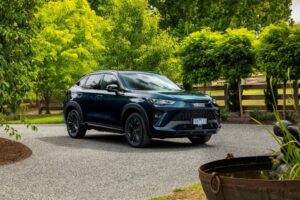
Foton’s Tunland diesel hybrid utility, that’s diesel hybrid — could make a few punters
sit up and take notice.
For starters it’s larger than your average 4×4 sports ute and although it is surprisingly
well equipped, it costs a lot less.
Tunland is billed as a full-size ute, but in reality, sits somewhere between the Ranger
and Ram 1500 in terms of size, with prices starting from $39,990.
If the name sounds familiar, that’s because the Chinese brand had a crack back in
the 2010s but failed to break into the Australian market. Will it succeed this time
around. Let’s find out, shall we?
STYLING
There are two models and two grades from which to choose — V7-C 4×2 and V7-C
4×4 and V9 L and V9-S (both V9s 4×4).
They are all powered by the same diesel hybrid powertrain, with V7 targeted at
tradies and the V9 at the leisure market.
Contrary to earlier reports both models are the same size, which means they are just
over 5.6 metres long — at least that’s what the spec sheet says.
V7-C 4×2 is priced from $39,990, V7-C 4×4 from $42,990, V9-L 4×4 from $45,990
and V9-S 4×4 from $49,990 — all prices before on-road costs.


Our test vehicle was the V9-L 4×4 which doesn’t want for much. The L is for luxury.
Tunland feels as big as it looks to drive, with a bluff, chromed trimmed grille and the
Foton name emblazoned on the tailgate, together with a full width light bar.
In blue, at least, it tends to stand out.
Standard kit includes artificial leather, tw0-zone climate air with rear outlets, an air
purification system, heated power-adjust front seats, with lumbar adjustment for the
driver and 256 colour ambient interior lighting.
There’s also 18-inch alloys, premium side steps, a sports bar, adaptive cruise
control, traffic sign recognition, LED head, tail and running lights, front and rear park
sensors, auto lights and wipers, auto dimming rear view mirror, and heated, power-
fold exterior mirrors.
Tunland is covered by a 7-year/unlimited kilometre warranty, with seven years of
roadside assistance to match, provided the car is serviced by Foton — plus capped
price servicing.

Service is due every 15,000km or 12 months, whichever comes first.
Competitors nearest in size include the 5500mm MG U9 Explore (turbo-diesel priced
from $52,990), 5500mm LDV Terron 9 Evolve (turbo-diesel priced from $53,674),
and the 5445mm GWM Cannon Alpha Ultra (petrol-hybrid priced from $64,990).
INFOTAINMENT
Infotainment comes in the form of a 14.6-inch touchscreen, separate 12.3-inch
instrument cluster, with Bluetooth, facial recognition, ‘Hi Foton’ voice recognition,
AM/FM radio, wireless Apple CarPlay, and six-speaker audio.
Missing are Android Auto, DAB+ digital radio, and built-in satellite navigation, leaving
Android users high and dry with no on-screen navigation at all.
There’s also wireless phone charging, two USB-A ports and a 12-volt outlet in the
front plus a 240-volt socket and another two USB-A ports in the back — but no USB-
C ports.
SAFETY
Tunland is yet to be rated for crash safety by the ANCAP organisation.
However, it comes with a comprehensive array of safety features, including eight
airbags, a 360-degree camera with integrated dashcam, and autonomous
emergency braking with pedestrian and cyclist alert.
There’s also forward collision warning, blind spot detection, lane keep assist, rear
cross traffic alert, pedestrian collision warning, tyre pressure monitoring, and trailer
stability assist.
There’s two ISOFix child seat anchor points for the back seat but no older-style top
tethers which might mean investing in a new seat.
ENGINES / TRANSMISSIONS
Power comes from a 2.0-litre turbocharged diesel with a 48-volt mild hybrid that
produces 120kW of power at 3600 rpm and 450Nm of torque from 1500-2400 rpm.
The hybrid is designed to add low down torque, with drive to all four wheels via an
eight-speed ZF auto and BorgWarner part-time four-wheel drive system, high and
low range, together with a rear diff lock.
DRIVING
Before we get going, I think some comparisons are in order.
Let’s compare the Tunland with the market leading Ranger and the Ram 1500 — the
smallest of the Ram pickups.
Tunland:
Length 5617mm. Width 2000mm. Height 1910mm. Wheelbase 3355mm. Ground
Clearance 240mm.
Ranger:
Length 5406mm. Width 1918mm. Height 1886mm. Wheelbase 3270mm. Ground
Clearance 234mm.
RAM 1500:
Length 5916mm. Width 2057mm. Height 1971mm Wheelbase 3672mm. Ground
Clearance 217mm.
As you can see Tunland is clearly larger than Ranger but smaller than a RAM. It also
has plenty of off-road potential, given the imitations of its size. Short vehicles
with lots of ground clearance perform best.
At the same time Tunland is cheaper than both competitors.
A petrol hybrid Ranger XLT costs $71,990, while the cheapest Ram, the petrol V8
Ram 1500 Big Horn — is a whopping $119,950 (both prices before on-road costs
have been added).
Given that Tunland comes in work and play configuration and is rated to tow a
3500kg braked load, it starts to look pretty good, on paper at least.
It looks even better when you consider it’s not just a hybrid, but in fact a diesel-
hybrid, that delivers the best of both worlds.
Gross vehicle mass is limited to 3355kg and the V9-L can carry a payload of 995kg.
At 5.6 metres, it is about 30cm longer than the fondly remembered Holden Crewman
utility and can make Tunland tricky to park as well as to manoeuvre around town.
It requires the driver to give obstacles a wide berth to ensure the tail comes around
cleanly and it means plenty of three-point turns are necessary in tighter situations,
and that includes U-turns.
The turning circle is 13.5 metres.
The transmission incorporates auto engine stop-start to save fuel, with selectable
drive modes and steering wheel-mounted gear shift paddles.
They include Eco, Standard, Sport, Sand, Mud and Snow.
A rotary control on the far side of the centre console provides control over the four-
wheel, with Auto, 2H, 4H and 4L settings.
Not sure what Auto is all about, given it’s a part-time system — but the knob is easily
brushed leading to unexpected results when you try to drive the vehicle (think
differential bind).
These settings by the way are also available from the touchscreen.
With a 76-litre tank fuel consumption is a claimed 8.0L/100km.
There’s also a 12-litre AdBlue tank that requires topping up occasionally. We were
getting 9.2L/100km after about 470km of driving (with 360km to go).
Suspension in the V9-L is double-wishbone at the front and a coil spring, multi-link
set up at the rear, with the promise of a more comfortable ride.
Brakes are four-wheel ventilated discs while the wheels are 18-inch alloys and
265/70 series Giti AT71 4×4 rubber, plus a full-size steel spare.
There’s no tonneau for the tub, but you get a black sports bar, spray-on tub protector
and four tie-down points.
There’s also no light or power outlets for the tub, but it can be key-locked.
Standard side steps make getting in and out of the cabin a little easier as do grab
handles for each of the doors, driver included.
Fit and finish is good and the cabin is roomy and comfortable, with plenty of elbow
room for the front seat occupants.
The front seats are heated as well as power-adjustable. Rear legroom is generous to
a point.
Plenty of storage in the front but the USB and 12-volt sockets are just about hidden
in the lower console area and not accessible once you’re on the move.
The drive experience is de rigueur for a turbo-diesel 4×4 ute.
It’s not particularly quick off the mark, but cruises easily and remarkably quietly,
making conversation easy.
And for a big ute, the steering is remarkably sharp and you can confidently chuck it
into a corner without unexpected results.
The vented, four-wheel disc brakes are good, but don’t seem to grab on the first
attempt, requiring a second heavier prod to get the desired result.
The 14.6-inch touchscreen is on par with competitors, with a row of easy access
buttons located immediately below the screen — but the main on-screen access
points are on the side furthest from the driver.
The lack of Android Auto or built-in navigation could be something of a deal breaker
for potential buyers, given the proliferation of phone cameras these days.
Apple users fare a little better with the provision of CarPlay connectivity.
Radio is AM/FM only — no DAB+ digital reception.
The unbranded six-speaker audio is fine and the front, door-mounted speakers even
score metal grilles.
SUMMING UP
It may not be perfect, but the Tunland offers plenty of utility for the money.
It’s big and brash, ready for work or play, and unexpectedly fun to drive, with nothing
much to spend.
Hopefully Android Auto will come with an update (are you listening, Foton)?
Foton’s local testing has paid off but as a relative newcomer, you have to make sure
you have all the bases covered — buyers are not forgiving creatures.
RATINGS:
Looks: 7
Performance: 7.5
Safety: 6
Thirst: 7.5
Practicality: 7
Comfort: 7.5
Tech: 7.5
Value: 8
Overall: 7.3
AT A GLANCE
MODEL LINE-UP
Tunland V7-C 4×2, $39,990
Tunland V7-C 4×4, $42,990
Tunland V9-L 4×4, $45,990
Tunland V9-S 4×4, $49,990
Note: These prices do not include government or dealer delivery charges. Contact
your local Foton dealer for drive-away prices.
SPECIFICATIONS: (Foton Tunland V9-L 4×4, 2.0-litre 4-cyl turbo-diesel hybrid, 8spd
automatic transmission, 4WD, Dual cab utility)
ENGINE
Capacity: 2.0-litre
Configuration: four cylinders inline, turbocharged with 48-volt mild hybrid
Maximum power: 120kW @ 3600rpm
Maximum torque: 450Nm @ 1500-2400rpm
Fuel type: Diesel / electric
Combined fuel cycle: (ADR 81/02) 8.0 L/100km
CO2 emissions 211 g/km
DRIVELINE:
Part-time four-wheel drive diesel hybrid, 8-speed conventional automatic
DIMENSIONS, WEIGHT, AND CAPACITIES
Length: 5617 mm
Width: 2000 mm
Height: 1910 mm
Wheelbase: 3355 mm
Kerb weight: 2315 mm
Turning circle: 13.5 m
Fuel tank: 76 l
BRAKES
Front: Ventilated Disc
Rear: Ventilated Disc
STANDARD WARRANTY
7 years / unlimited kilometres