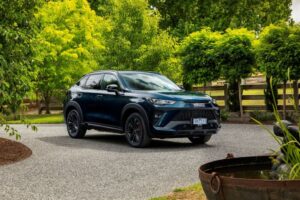
Inster is Hyundai’s smallest and most affordable SUV. Built on the same platform as the
Picanto from Hyundai’s sister company Kia it’s marginally larger but more than double
the price. Most of that price premium is because Inster is any EV on a compact SUV
body whereas Picanto is a 1.2-litre petrol hatchback.
Inster is effectively a fully-electric version of the petrol-powered Hyundai Casper SUV
that went on sale in its home South Korean market in 2021 but never made it to
Australia.
Inster’s closest Kia rival is the EV3 which has some similar design features but is built
on a different platform, is larger and more expensive. Other competitors include the
more expensive European Fiat 500e and the Chinese-sourced GWM Ora and BYD Atto
1.
Inster comes with the choice of three variants: Standard Range, Extended Range and
Cross Extended Range.
Prices start at $39,000, on-road costs, for the Inster Standard Range. The Extended
Range is $42,500, while the Inster Cross, with Roof Basket option, or sunroof tops off
the list at $45,000.
Warranty is five years unlimited kilometres and eight years,160,000 kilometres on the
high-voltage battery.
STYLING
With its blend of past and retro and futuristic contemporary elements Inster is quite a
head turner. The rounded front combines both with round Mini-like headlights / daytime
running lights with its EV charging port in the centre.
The rear doors come with the awkward high-mounted ‘disguised’ handles that just ask
for fingers to be
In contrast to the moulded front design the rear is square and almost vertical although
the rounded red brake lights copy those at the front.
There are Parametric Pixel LED combination llights, rectangular LED turn signals and
circular reflectors.
Standard Range and Cross run on conservatively styled alloy wheels, 15-inch on the
Standard, 17-inch on the Cross . By contrast, the 17-inch alloys on the Extended Range
have a much more dramatic design that look like four axes welded together.
The use of eco-friendly high-gloss paint, recycled from waste tyres, backs up Inster’s
environmental credentials.
Extended Range adds a sunroof with a manual sunshade. Buyers of the Cross get the
option of a removable roof basket with a carrying capacity of 75 kilograms.
INTERIOR
Hardly a surprise but Inster comes with only four seats but it does provide those
occupants with reasonable comfort. There’s plenty of headroom and acceptable
legroom although the driver and front passenger will find their elbows bumping against
each other. There is a folding centre armrest above twin cup holders but no storage box.
The narrow width also limits the storage space within the doors although the there is
space at the bottom of the front console. Below that, at floor level, there is a full-size
power outlet that allows external devices to be used.
The rear seats provide a surprising amount of space for its two occupants in all areas.
Being an EV there’s a flat floor and both seats slide back and forward and recline. As in
the front the side door pocks are very narrow and there are no pockets on the back of
the front seats.


Boot space does suffer with cargo limited to 280 litres with seat backs in place,
expandible to 351 litres with them folded.
The Standard Range has cloth seats made from recycled PET. The Extended Range
gets artificial leather appointed seating, heated and ventilated front seats, leather
steering wheel, 64-colour ambient mood lighting, powered side mirrors and a wireless
charging pad.
INFOTAINMENT
Both variants come with a 10.25-inch digital cluster and 10.25-inch infotainment
touchscreen incorporating satellite navigation with Bluelink live traffic reports.
Hyundai Bluelink connected services, complimentary for the first five years includes
automatic collision notification with SOS function, live traffic updates, remote control of
climate and vehicle functions, plus voice recognition for points of interest.
Android Auto and Apple CarPlay are standard.
Both models get the same six-speaker audio system.
With over-the-air technology, vehicle navigation software can be updated remotely by
following on-screen prompts.
POWERTRAIN
Both Inster variants are powered by a single front-mounted electric motor but with
different outputs
The motor in the Standard Range generates 71.1kW of power through a 42kWh battery
for a claimed WLTP range of up to 327 kilometres. The Extended range increases this
to 84.5kW from a 49kWh battery and 360 km.
.
Plugged into a DC charging station, delivering 120kW or more, it’s claimed Inster will
fast charge from 10 to 80 per cent in as little as half an hour. In practice, the test vehicle
on a 27.10kWh charge went from 30 to 90 per cent in less than 40 minutes.
SAFETY
Hyundai Inster underwent ANCAP testing in January 2025 but only achieved a 4-star
rating. It fell slightly short on the required score for adult occupant and vulnerable road
user protection.
Standard features include seven airbags, including front, front side, side curtain, and a
front-centre airbag.
A comprehensive suite of Advance Driver Assistance Systems (ADAS) is standard and
includes autonomous emergency braking (Car-to-Car, Vulnerable Road User, Junction
and Head-On) as well as a lane support system with lane keep assist (LKA), lane
departure warning (LDW) and emergency lane keeping (ELK), and an advanced speed
assistance system (SAS).
Highway driving assist uses a windscreen-mounted camera, radar and navigation data,
to assist the driver keep a set speed and distance from the vehicle ahead, while keeping
Inster centred in the lane.
Also, at the behest of this camera, intelligent speed limit assist combines road sign
recognition with navigation data to tell the driver the current speed limit. An in-cabin
camera, by checking the face, makes the driver aware of drowsiness or inattention with
an alert, or start preventive action to avoid an accident.
Both rear seats come with ISOFIX child seat anchors.
DRIVING
While there are some issues caused by the interior space in the Inster it’s an absolute
delight to drive especially in its urban natural habitat. The combination of its compact
dimensions and EV sharpness make it easy to maneuver in and out of traffic while its
small footprint makes it easier than just about anything else on the road to park.


Smart Regenerative Braking can be adjusted via paddle shifters on the steering wheel
including a full single-pedal (i-Pedal) mode that can bring the car to a complete stop.
The motor is fixed to the body by fluid bushes which improve ride quality and reduced
vibration when compared to with conventional rubber fixings. High-performance
dampers deliver optimal body control shock absorption for a soft and compliant
suspension.
Comfort at higher speeds benefits from a reinforces steering system structure,
optimised steering damper and steering wheel designed to cut vibration transfer.
The cabin has double door seals and thick front door glass which in conjunction with the
absence of engine noise adds to the Inster’s refined feel.
SUMMARY
The two features that figure prominently in discussions about the Hyundai Inster are that
it’s too small and/or too expensive.
While Inster is amongst the smallest vehicles in the Australian market the combination
of its agility, interior space and economic running costs make it perfect for urban
commuters.
In terms of price, it’s not that long ago that all fully-electric vehicles started with a plus-
$40k price tag. That’s all changed now with many Chinese EV’s now priced well below
that threshold. Nevertheless, there are now many locked-in Hyundai buyers that are
shopping around within the brand’s growing range of EV’s who will be willing to pay the
asking price for the appealing qualities of the Inster.
RATINGS
Looks: 8
Performance: 8
Safety: 6
Thirst: 9
Practicality: 7
Comfort: 7
Tech: 8
Value: 7
AT A GLANCE
MODEL LINE-UP
Hyundai Inster Standard Range $39,000
Hyundai Inster Extended Range $42,500
Hyundai Inster Extended Range Cross with Roof Basket $45,000
Note: These prices do not include government of dealer delivery charges. Contact your
Hyundai local dealer for drive-away prices.
SPECIFICATIONS (Hyundai Inster Standard Range,1sp auto, FWD SUV)
POWERTRAIN
Electric motor: Front-mounted permanent magnet synchronous motor
Maximum power 71.1kW
Maximum torque: 147Nm
Maximum voltage: 266V
DRIVELINE: 1 Speed Automatic Transmission (Reduction Gear), FWD
BATTERY: Nickel, manganese, cobalt
Energy: 42kWh
PERFORMANCE:
Driving range: 327km
Energy consumption: (claimed) 14.3 kWh/100km Standard Range; 14.9 kWh/100km
Extended Range
CHARGING:
DC Fast Charge 10-80% (120kW Charger) Approx. 30m
DC connector: CCS type 2
AC Charge 10-100% – (16A) 4hr 35min
DIMENSIONS, WEIGHT, AND CAPACITIES
Length: 3825mm
Width: 1610mm
Height: 1575mm
Wheelbase: 2580mm:
Turning circle: 10.4m
Kerb weight: 1845kg
BRAKES
Front: Ventilated disc
Rear: Disc
STANDARD WARRANTY
Five years / unlimited kilometres
Eight years / 160,000 kilometres, battery