Stricter crash testing procedures will be introduced under changes flagged by the Australasian New Car Asessment Program (ANCAP).
From 2026, a notable update strengthens how ANCAP evaluates the safety of new cars across the stages of safety: safe driving, crash avoidance, crash protection and post-crash.
A major change reflects the important of crash response time, with a greater emphasis on the availability and performance of automatic eCall systems.
More than 40 percent of all new vehicles sold in Australia in 2024 featured technology capable of automatically connecting with emergency services following a crash, known as eCall.
“Our updated protocols set a clear benchmark for emergency call systems fitted in vehicles,” ANCAP’s Carla Hoorweg said.
“We want to encourage manufacturers to enhance existing systems and provide an incentive for all brands to fit this life-saving technology.”
As part of the revamp ANCAP will also perform more on-road testing to better track the real-world capability of the technology on board.
This on-road evaluation will examine how well the vehicle’s technology reads and responds to road conditions and will give ANCAP more detailed insights into a driver’s experience beyond the test track.
The updates ensure ANCAP’s testing, analysis and ratings remain the authoritative guide for consumers and fleets which value independent information on the safety of the latest cars, SUVs, utes, and vans.
To give the changes some perspective, ANCAP re-examines the star rating criteria every three years, with a sole focus on reducing vehicle-related deaths and serious injuries.
And this time around several changes have been made specifically in response to consumer feedback.
“Active driver assistance systems – often criticised for their abrupt or irritating interventions – will be rewarded for smooth, intuitive operation as well as technical performance,” Hoorweg said.
“Increasingly popular electrically-operated door handles – which sit flush with bodywork when not in use – should remain operable after any crash.
“Electric cars should isolate their high-voltage battery after a serious crash, and the vehicle should be able to notify first responders of the crash.”
She added that ANCAP’s role is to continually push for improvements in all areas of vehicle safety and the 2026 protocols reflect that.
“The outcome will be better protection of vehicle occupants and those around them, through the active prevention of crashes, superior protection in the event of a crash, and improved post-crash management,” she said.
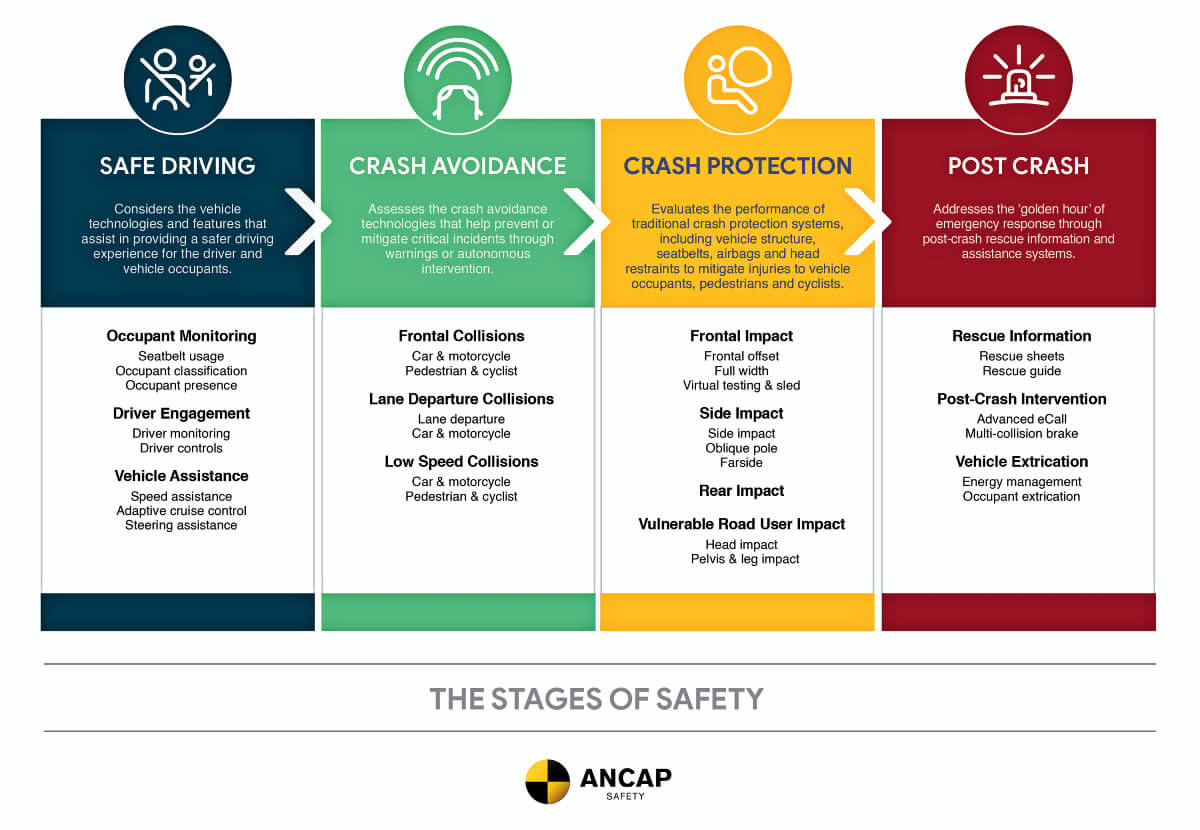
Stages of Safety at a glance
The four assessment areas that will be evaluated from 2026 are:
- Safe driving – Considers the vehicle technologies and features that assist in providing a safer driving experience for the driver and vehicle occupants.
- Crash avoidance – Assesses the crash avoidance systems that help prevent or mitigate critical incidents through warnings or autonomous intervention.
- Crash protection – Evaluates the performance of traditional crash protection elements, including vehicle structure, seatbelts, airbags and head restraints to mitigate injuries to vehicle occupants, pedestrians and cyclists.
- Post crash – Addresses the ‘golden hour’ of emergency response through post-crash rescue information and assistance systems.

CHECKOUT: ANCAP turns spotlight on trucks
CHECKOUT: ANCAP — the safety story 30 years on